
There’s nothing like Isaan guitar music from Thailand. A perfect blend of blistering psychedelia, improvisation, and traditional eastern modes, it combines so many things that I love about music, that once I go down the rabbit hole, it’s almost impossible to get out. I’ve been totally obsessed with it for years. This remarkable music seems bridge northern Thia culture. It’s performed at the formal functions, weddings, and on the street. Unfortunately very recordings have reached the west. I’ve spent countless hours on searching out as much as I can online, and thought I’d share some of my favorite video clips. The incredible two hour marathon, featured above, is Khun Narin’s Electric Phin Band. I notice an edited version of this blew up on social media a few months back, and caught the attention of the mainstream media. They’re one of the few bands have have readily available recordings. You can check them out here. Continue reading “a collection of isaan guitar music from thailand”
Month: February 2016
joan la barbara vocalizing the alphabet on sesame street in 1977
My dear friend Koen just sent this to me, via our mutual friend Byron, in response to my post on Joan La Barbara. Thanks to them both. I have a palpable memory of the sequence, and particularly the sound, from childhood, but haven’t seen it since. It’s a wonderful fragment from a time when experimental music bled into the mainstream, and planted its seeds in us all. Hope you enjoy it as much as I do.
field recordings by pauline oliveros from the san diego zoo, recorded on Nov. 14, 1968
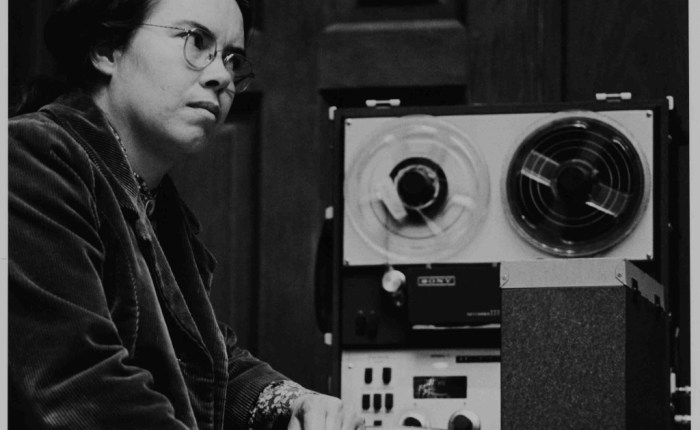
a great performance of steve reich’s pendulum music 1968
This is the only filmed document of Steve Reich’s Pendulum Music from 1968, that I’ve seen. The performance took place in 2014 at Centro Jose Guerrero in Granada, Spain. Wait it out. It gets great toward the end.
photo album for the 1960’s & 70’s american avant-garde
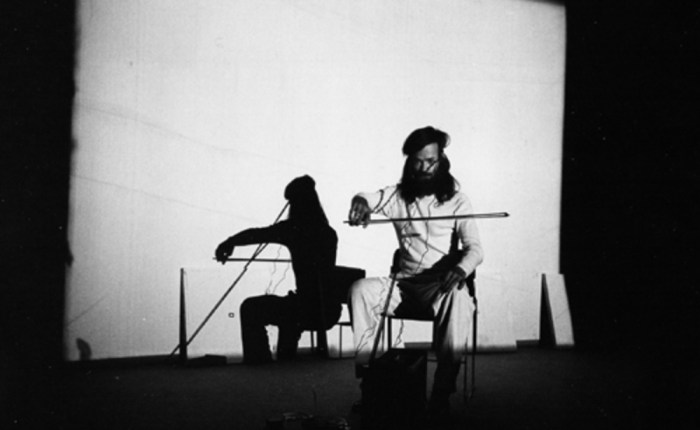
Everyone has seemed to love the photo albums I posted on La Monte Young and Joan La Barbara, so I thought I’d round it out, and broaden my subject to the breadth of avant-garde music from the 1960’s and 70’s. This is one of my favorite periods of music. These are images that I’ve collected while wanderings around the internet. I’ve done my best to cover as broad a range as seemed reasonable (roughly 60 images), but I haven’t managed to be as inclusive as I might have liked. Let’s chock it up to taste for now, as those represented are among my favorites of the generation. I hope you enjoy, and that they give you a window into an incredibly exciting period of thought, experiment, and sound. Continue reading “photo album for the 1960’s & 70’s american avant-garde”
a beautiful portrait of eliane radigue
One of most remarkable forces in post-war avant-garde music. There are few who I adore more.
the amazing mandolin sisters
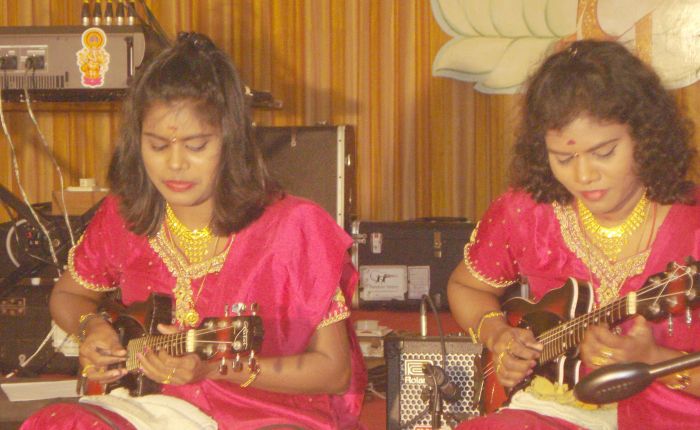
Anyone who knows me, or has visited The Hum and read my Introductions to Indian Classical Music Part 1 and Part 2, knows of my devotion to Hindustani and Carnatic music. The musical traditions of India are among the oldest on the planet. Their influence on the diverse cultures they have touched, over millennia, are incalculable. Chances are, where ever you are, no matter what sounds you prefer, Indian music has helped sculpt the music you love. Continue reading “the amazing mandolin sisters”
The Abdul Wadud Ensemble, Studio WIS, N.Y.C., 1980
I recently discussed my adoration for Abdul Wadud over at The Hum. While I was writing the previous entry on Kalaparusha Maurice McIntyre, I came across this incredible recording from 1980 of Wadud’s Ensemble. It’s short, but packed with remarkable sounds. Apparently a full recording of the evening exists. I hope it sees the light of day. The performers are Abdul Wadud, Joe Daley, Warren Smith, Kalaparusha Maurice McIntyre, Hafiz Shabbaz, Bill Cole, and others. Studio WIS was a prominent venue during New York’s Loft era of Free-Jazz – run by the percussionist Warren Smith. Enjoy and cross you fingers for more.
a ballad for kalaparusha maurice mcintyre
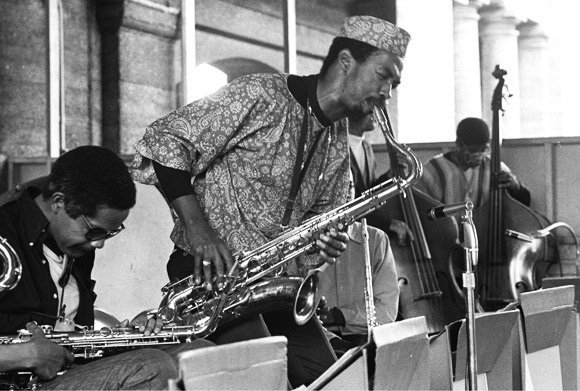
Many years ago, when first I encounter Chicago’s Association for the Advancement of Creative Musicians (AACM) and was working through the catalog of their early gestures, I found myself reading the back of Anthony Braxton’s Three Compositions Of New Jazz. The album was the forth in a serious of recordings by members of the collective, proceeded by Roscoe Mitchell’s – Sound, Joseph Jarman’s – Song For, and Muhal Richard Abrams’ – Levels And Degrees Of Light. Buried in its exploratory text, was the mention of a young tenor saxophonist, Maurice McIntyre, who Braxton believed to be the most important since John Coltrane.
Continue reading “a ballad for kalaparusha maurice mcintyre”
terry riley live in the 70’s
This appears to be part of the same document as the previous post.
 The Hum Blog